Victoria Kucherova
Victoria Kucherova
Founder and CEO
Leads strategy, research, partnerships and long-term vision.
VitaNova engineers, builds, and transfers the complete growing system that brings it back.
The problem
Severity is an indicative classification of documented salt-affected and brackish-irrigation regions, not precise per-acre data. Sources: USDA; FAO 2024; USGS 2017; Bureau of Reclamation; Welle and Mauter 2017; Texas A&M AgriLife 2024.
Brackish groundwater beneath the US holds 800x current annual use.
Across the irrigated West, long growing seasons and abundant sun create the conditions for productive agriculture. In many places, the real limitation is not the climate - it is what sits beneath it.
Where evaporation outpaces rainfall, irrigation can leave salts behind in the soil and concentrate them in the water. Over time, land that should be productive becomes increasingly difficult to farm.
But those constraints can be measured and engineered around. Test the water. Understand the soil. Treat the source where necessary, or isolate the crop from unsuitable ground with a controlled root zone.
The climate provides the opportunity. The system is designed to unlock it.
The method
Written-off ground, priced as if nothing will grow on it again. The first move is finding it and reading what it actually is.
A current water test and a look at the ground. Salt-affected water, poor soil, or both. This one reading decides everything downstream.
If the waterReverse osmosis brings it down to about 0.75 mmhos/cm, then it is rebalanced crop-ready.
If the soilThe crop grows in engineered containers, the root zone isolated from the native ground.
A site can need either, or both.
Grants and district cost-share programs can cover 50 to 75% of the capital. The cost is not the reason to stop.
The premium, salt-sensitive crop the land could not carry before, grown on treated water and sold into the window where domestic supply is thin.
Written-off ground back in profitable production, on the same acres, with the same water.
Same land. Same water.
What we do
The six steps of the method, offered as work. A site can need all of them or only some, and the reading in step two is what decides which.
01
Find the land
Written-off ground, priced as if nothing will grow on it again, and the case for whether it can.
02
Test the water and soil
A current water analysis and a reading of the ground. This one reading decides everything downstream.
03
Treat the water, or bypass the soil
Reverse osmosis down to about 0.75 mmhos/cm and rebalanced crop-ready, or an engineered root zone isolated from the native ground. Often both.
04
Work out the funding
Which of EQIP, Basin Salinity Control and WaterSMART a site qualifies for, and what each of them carries.
05
Design the system for the site
Treatment, rebalancing, fertigation, root zone, canopy, harvest and the control loop, specified together. The integration is the product.
06
Prove it on the ground
Everything above is running at Etherealberries, on land a laboratory declared unusable. It can be walked.
Designed per site. Never sold as a fixed kit.
The method proven at commercial scale on land a laboratory declared unusable. LaBelle, Florida.
A laboratory declared this farm's water unusable, and the crop is growing on it anyway.
Source
2.0 to 2.7
mmhos/cm
Treated
0.75
mmhos/cm
99%
of the fresh blueberries the US eats from January to mid-March are imported.
About 66% imported across the full year.
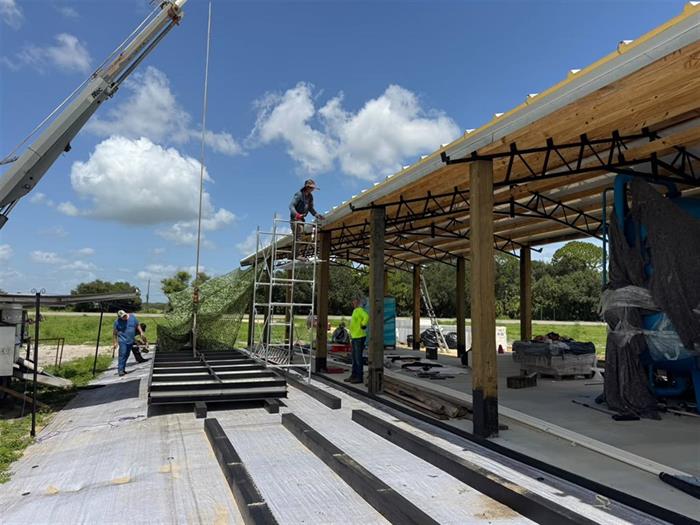
01
The building goes up
Steel down, roof going on. The shell that everything else arrives into.
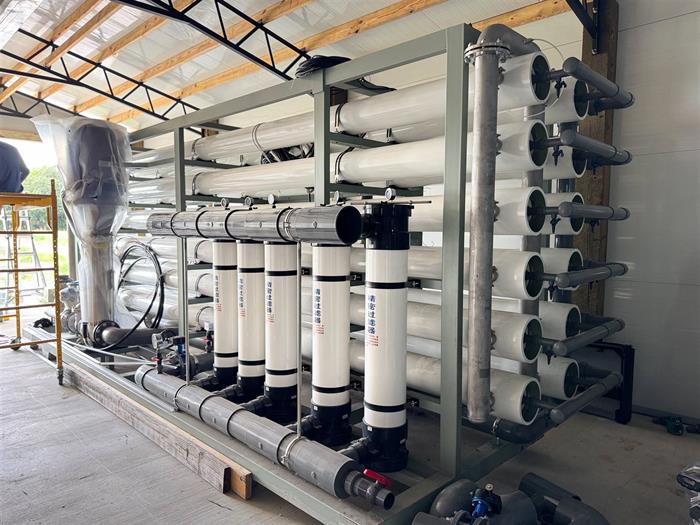
02
Reverse osmosis
The stage that brings the source water down to about 0.75 mmhos/cm.
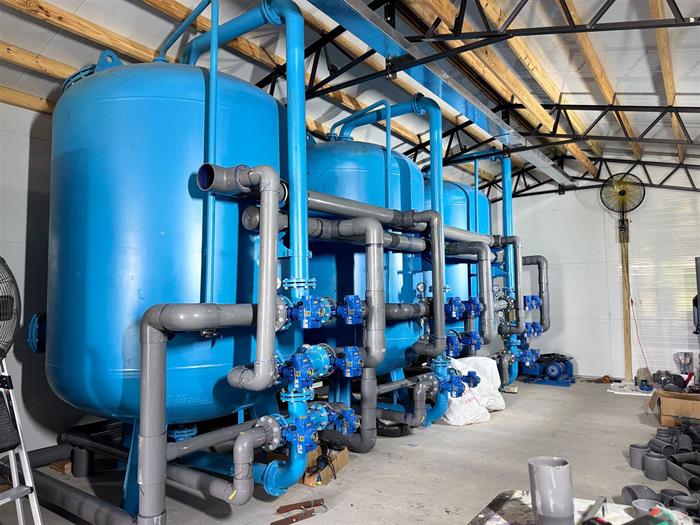
03
Filtration
Vessels and valves inside the building, between the source and the field.
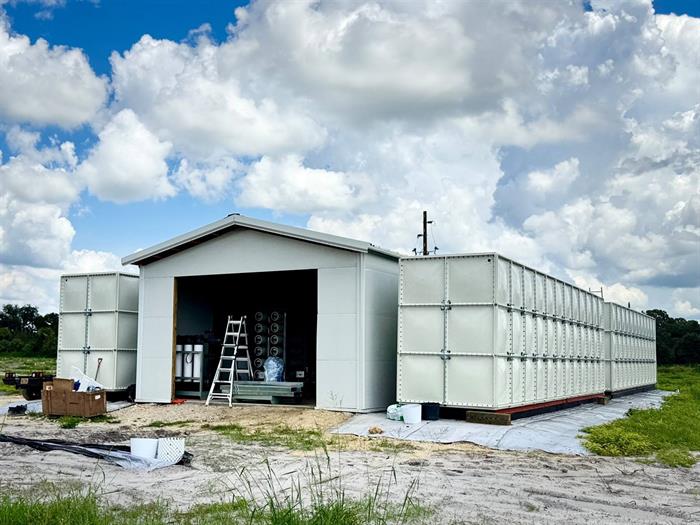
04
The building, finished
The system housed, with the tank bank ranged along its side.
05
The crop goes in
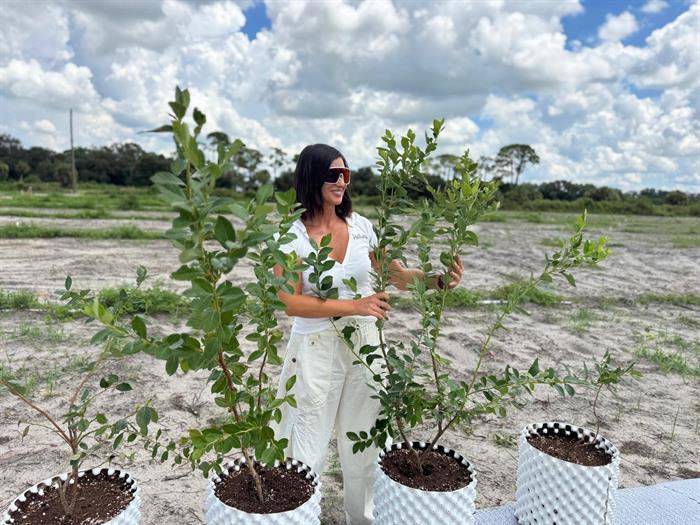
Engineered containers on the sand, the root zone isolated from the native ground.
Interactive system model in development
The integration is the product, not any single component.
Water treatment
Salt out at the source. Reverse osmosis brings 2.0 to 2.7 down to 0.75 mmhos/cm.
Rebalancing
Pure water made crop-ready, remineralized and acid-corrected to about pH 5.
Precision fertigation
Organic inputs dosed by recipe and verified at the root zone.
Engineered root zone
The crop never touches the native soil. High-density air-pruning containers.
Adaptive canopy
One folding structure against sun, heat, freeze and birds.
Contactless harvest
Pulsed air detaches only the ripe fruit. No hand-picking, no bruising.
Sensor and control loop
The layer that turns good components into one self-correcting system.
Land
42 acres
Fee simple, 36 acres permitted.
Water use permit
SFWMD 26-113135-W
Water analysis
5-well independent lab
Waters Agricultural Laboratories.
Schedule
Planting fall 2026
First commercial harvest spring 2027.
Faculty and staff from the UF/IFAS blueberry program have visited Etherealberries, walked the full system, and discussed it on site.
The same treated water, engineered root zone and control loop serve other high-value crops on salt-affected land, in the Rio Grande, the Colorado Basin, California and Florida.
Strawberry
Gross value per acre: to be supplied
California
Raspberry
Gross value per acre: to be supplied
Colorado Basin
Blackberry
Gross value per acre: to be supplied
Rio Grande
Avocado
Gross value per acre: to be supplied
Florida
Designed per site, not sold as a fixed kit.
Who we are
VitaNova AG Technologies was founded by Victoria and Dmitry Kucherov after more than two decades building businesses in other industries. Rather than buy a farm, they engineered a blueberry production system from the ground up, on land a laboratory had declared unusable.
That farm is Etherealberries, and it is where VitaNova comes from. Every constraint the site imposed, every component that did not survive contact with it and every correction made along the way went into the method. The expensive part of this work is finding out which assumptions are wrong, and on this system that has already been paid for once.
Which is what VitaNova is for. The farm was never the product. The product is the system behind it, engineered for a site rather than assembled from a catalogue, and built to be specified again on ground nobody has walked yet: a different basin, a different water, a different crop, the same seven layers and the same control loop. One farm proves it. The company exists to transfer it.
Victoria Kucherova
Founder and CEO
Leads strategy, research, partnerships and long-term vision.
Dmitry Kucherov
Operations
Leads engineering, infrastructure, construction and daily farm operations.
We were never trying to build another blueberry farm. We were trying to build a system that can be engineered once and handed to the next piece of land.
Victoria and Dmitry Kucherov